Building information modelling (BIM) is not being used to its full potential in the Gulf region and is sometimes employed purely to satisfy contractual obligations, experts say.
“What we’re sadly seeing in some contracts is that BIM is just being used as a bolt-on so the traditional methods of contract management, project management and quantity surveying tools are still being used,” says Robert Jackson, director of the Royal Institution of Chartered Surveyors (RICS) Middle East and North Africa.
“In some cases the BIM system on a project is simply being populated with data retrospectively to satisfy the contract requirements. In such cases, none of the parties are getting the true value of BIM.”
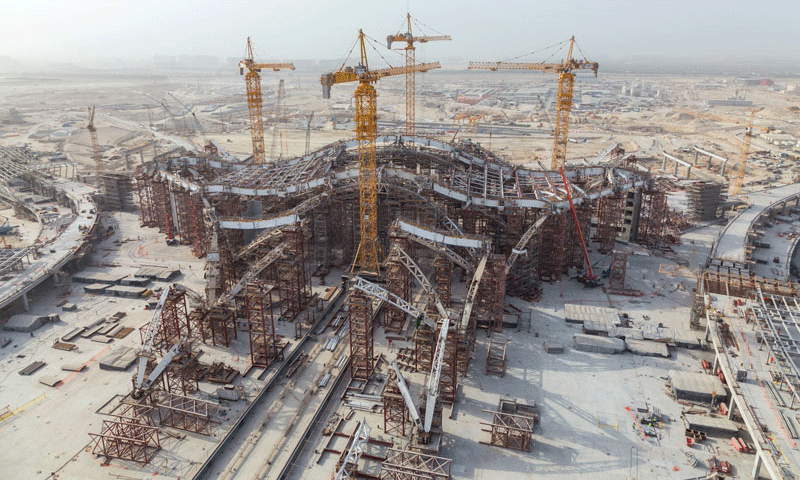
Despite the challenges with slow adoption, regional projects such as the Abu Dhabi Midfield Terminal Building are now successfully using BIM, Jackson says.
Steven Batchelor, Operations Director at Faithful + Gould in Abu Dhabi, points out that the reason why BIM uptake has been slow in an otherwise tech-savvy market might have to do with the recent financial crisis. “BIM is still in its infancy here in the GCC. We’re just coming out of a recession here to start with so the industry has been quiet for a few years.”
“If there hadn’t been a recession, no doubt everybody would be embracing it, it would have been a natural progression. But as they’re all slightly coming out of their shells again, it is taking a while to foster,” he says.
Using BIM effectively on a project requires collaboration between different stakeholders, says Luay Azzam, executive director of construction consultancy N. E. Azzam & Partners.
“While BIM is still wishy-washy, it is certainly something that should be considered because it will help in the life cycle of the building. Various team members should come together, and start talking in the same language. So still there is more to be done.”
Jackson points out that the collaborative nature of BIM is its biggest advantage. “That’s one of the hidden benefits that BIM does bring, it forces the parties to work more collaboratively on projects,” he said.