Renault Trucks Middle East is planning on expanding its business and aftersales capabilities in Iraq, undeterred by the conflict in the country, says a senior executive.
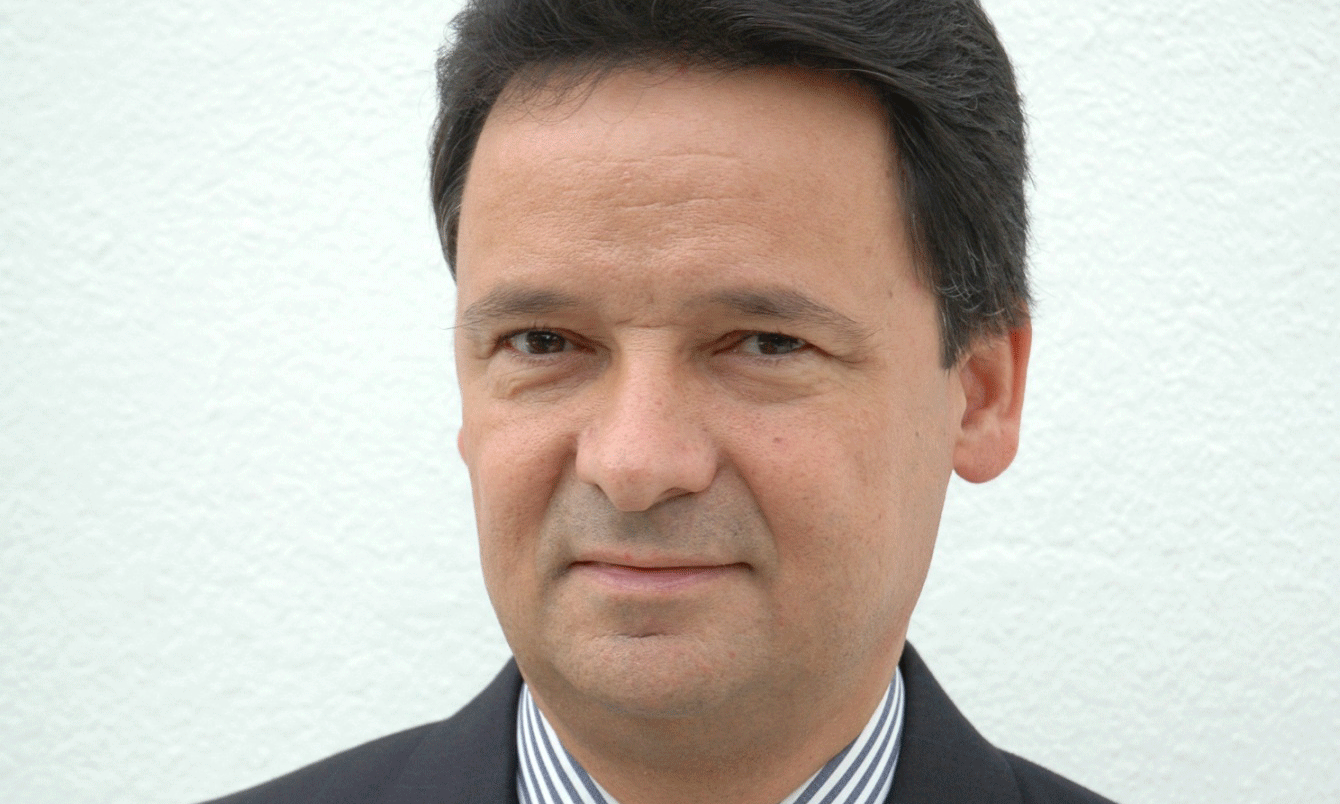
The company recently appointed Iraqi firm Sunflower General Trading Company to be its exclusive distributor in the country. The rationale behind the move is to boost aftersales services and support for customers, explained Bernard Amiel, business team director of Renault Trucks Iraq.
This is because aftersales is a key requirement for Renault’s customers in Iraq, nearly all of which are public sector entities, Amiel told staging.bigprojectme.com/.
“They want to be sure that they can get the parts, that they can get any technical support from the local representatives when they need to repair the truck,” he says.
As trucks grow even more sophisticated, it’s increasingly hard to get them repaired at ordinary workshops, further necessitating professional aftersales support.
“You have more and more electronics and the only way to find what’s wrong with the vehicle and to repair it is to have trained and specialised people. That’s why [customers] want to make sure before they buy a truck that they will be supported locally.”
In order to boost Renault’s aftermarket offering, Sunflower General Trading will be building a new 1,000sqm workshop in Baghdad, set to open in the first quarter of 2016. Spare parts will be brought in from Renault’s facility in Jebel Ali, from where they will be air-freighted, depending on urgency, or shipped via the Iraqi port of Umm Qasr.
“Luckily the port of Umm Qasr is still an entry port which is safe, contrary to the entry point from Iraqi border where there are very few trucks coming in,” Amiel said.
Goods were earlier shipped by Renault to Iraq via the Gulf through the Umm Qasr Port, or through the Red Sea to Jordan’s Port of Aqaba, after which they would be transported via land to Baghdad. However, the land link is no longer safe anymore, he added.
Business affected
Despite Renault’s plans for Iraq, there’s no denying that political and economic factors have taken their toll on truck sales in the country, Amiel admitted.
“The truck business has been affected a lot since the beginning of the year, mainly for two reasons. One is the drop of the price of the oil. Then of course there is the war.”
As the government’s resources are now mainly being spent on efforts to fight the extremist group Daesh, other ministries – which constitute Renault’s clientele – are facing budget cuts, further posing a challenge for doing business in Iraq. This means that offering flexibility in financing will be key going forwards if Renault Trucks hopes to sell vehicles to government clients, Amiel said.
Despite the rocky road ahead, the French manufacturer, and its parent company Volvo, still “believe in Iraq,” Amiel said.
“There is definitely a commitment from the group to be present. We believe in Iraq. But to tell you when it will really pick up, we don’t know. Let’s hope that the situation will improve and the funds which are generated from the sales of the crude oil will be allocated to rebuild the country and buy more trucks.”