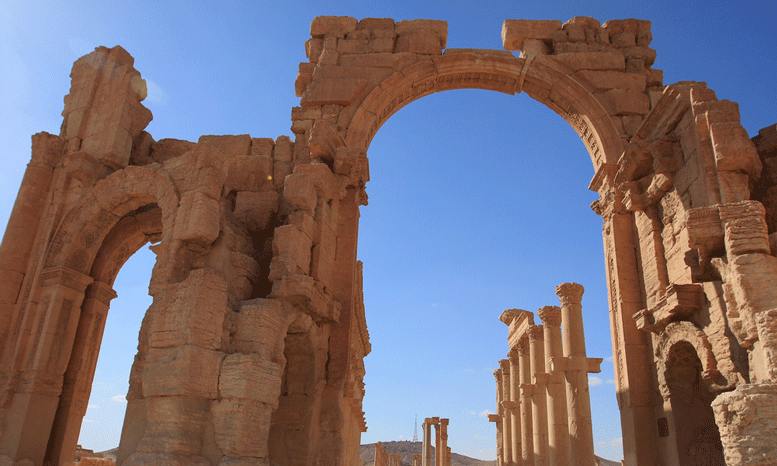
A replica of an 1800-year-old Roman arch that was destroyed by ISIS militants last year has been unveiled in London.
The initiative to build the two-thirds scale replica of the iconic Arch of Triumph, which stood in the ancient Syrian city of Palmyra, is a partnership between the Dubai Museum of the Future Foundation, the Institute for Digital Archaeology (IDA), UNESCO, and the universities of Harvard and Oxford.
The replica, which currently stands in London’s Trafalgar Square, will be exhibited in New York and Dubai, the UAE state news agency WAM reported.
The unveiling of the arch in front of the UK’s National Gallery was attended by Saif Al Aleeli, executive director of the Museum of the Future, as well as the Mayor of London, members of the British Parliament and specialists in archaeology and research.
The arch was restored using advanced digital imaging and 3D modelling techniques as part of an effort to document and preserve key historical artefacts.
The restoration uses a technology known as Polynomial Texture Mapping, which creates a 3D model of objects, it was reported.
The technique will be used to preserve at-risk monuments in areas hit by conflict throughout the Middle East and North Africa through the collation of the ‘Million Image Database’, an initiative backed by Dubai’s Museum of the Future Foundation. The database comprises 3D images taken by volunteers using thousands of special cameras distributed by the IDA. The pictures can then be uploaded for research and study by archaeologists and historians worldwide.
“The Million Image Database means we can not only record, preserve and study objects of great heritage against loss and damage, but also share facsimiles of them to exhibit to people around the world,” Al Aleeli said.
Commenting on the technique, IDA’s executive director Roger Michel said: “Perhaps the most exciting aspect of this technology is that we can not only preserve objects and examine them in a highly granular way, but we can print them using 3D printers and proprietary cement, sandstone and marble materials and machining.”
“Our mission is to rebuild the landscape of the Middle East and the great symbols of our shared cultural heritage that have been destroyed.”